
Aged care assessment study pinpoints where improvement is needed
The single assessment system for aged care services will be introduced in 2024 and recently released study findings have highlighted where improvements from the current systems are necessary.
Last updated on 4 December 2023

The introduction of a single assessment system for aged care services in 2024 is intended to simplify and improve access for consumers and new study results have pinpointed the exact areas where improvements need to be made.
Nous, an international management consultancy firm, reviewed the current aged care assessment program, finding that the time it takes to complete aged care assessments could be reduced by incorporating new technologies, increasing responsiveness and better embracing client needs.
Key points
- Nous observed and detailed specific activities that occurred during the assessment, how long they took to complete, the people involved and the variability and complexity of workload and assessments
- A total of 30 Aged Care Assessment Teams (ACATs) were observed for roughly 750 hours with the average assessment process lasting five hours
- Assessments in regional locations were roughly 15% longer while assessments for culturally and linguistically diverse (CALD) populations were also longer than average
- Four key areas were identified to inform the implementation of the single assessment system: efficiency, flexibility, responsiveness and visibility
A change of system
From July 1, 2024, there will be a new single assessment system for people seeking access to aged care services. It replaces several existing systems, including the Regional Assessment Service (RAS), ACATs and independent Australian National Aged Care Classification (AN-ACC) assessors. Additional First Nations assessment organisations will follow from July 1, 2025, to provide culturally appropriate assessments.
The single assessment system is one of many reforms intended to simplify aged care. Currently, there can be a lack of cohesion and coordination between assessment organisations when older people move services. The single assessment will be designed to streamline all data collection and analysis, creating one point of reference.
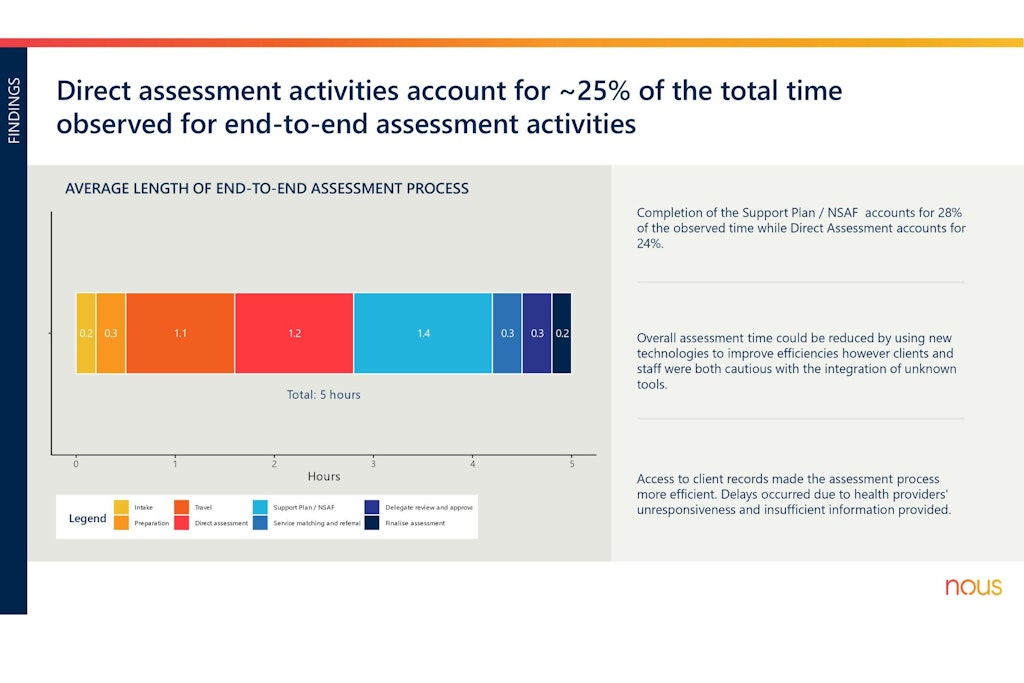
One of the main benefits will be increasing efficiency by reducing the need for repeat assessments if someone changes services.
- Roughly 15% of assessment activities are related to direct assessments, while 67% of the time is spent on activities related to the assessment but not involving the person being assessed
- A further 18% of the time involves activities directly not attributable to assessment, including training and certification, managing performance and administrative tasks
- The average end-to-end assessment lasted five hours with the completion of the support plan (1.4 hours), direct assessment (1.2 hours) and travel (1.1 hours) taking the most time
- It takes 18 more minutes to complete the assessment for CALD clients while it was 36 minutes shorter for Aboriginal and Torres Strait Islander clients with shorter direct assessment times a key factor
However, there is great variation in the duration of assessment, highlighting the unique circumstances aged care assessors face. Some direct assessments were completed within half an hour, others lasted more than two, while support plans could be completed within the hour, others three or four.
Nous listed several critical factors affecting assessment and support plan duration, such as:
- Client and support plan complexity
- The client’s understanding of the process
- Involvement of other parties
- Difficulty accessing relevant information
- The need to duplicate steps
- Unexpected interruptions or logistical challenges
- Technological difficulties
Enablers and challenges identified
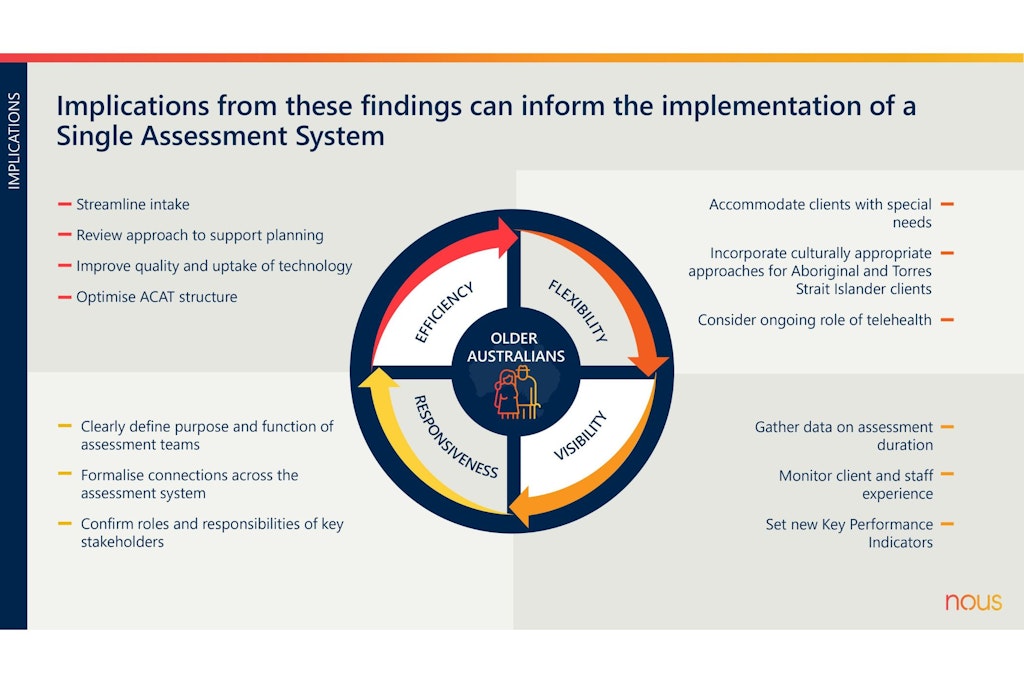
With the single assessment system in the final stages of development ahead of its July launch – pending any delays – the findings from Nous will have a significant impact.
Key observations include:
- The use of experienced clinicians in triage roles can streamline processes
- Strong relationships across the broader health network support effective care coordination
- Telehealth and virtual care can facilitate efficient assessments
- Modified assessment tools allow for more culturally appropriate assessments
These findings provide an informed foundation for the Department of Health and Aged Care to work on. And this is where assessment teams should hopefully benefit from the four focal points of efficiency, flexibility, visibility and responsiveness.
With issues surrounding administration, logistics, task duplication and technology uptake, the new system must be designed for purpose from the very beginning. Both aged care consumers and assessment teams need to easily gather data, work with external teams and accommodate the needs of all involved.
Not only would this make the end-to-end assessment process more efficient, but it would ensure the system is more adaptable to change and collaboration across services.
The complete findings from the aged care assessment program study can be found here.


