
The skills that built Australia’s healthcare system were never counted as skills
SEO excerpt The NSW IRC found in April that nursing’s core skills were never formally evaluated in wage-setting. The decision gives 70,000 nurses a pay rise and may have national implications. New ACN and ANMAC research is asking why internationally qualified nurses remain so absent from leadership.
Last updated on 11 May 2026
In April, the NSW Industrial Relations Commission named what nursing actually requires. The decision delivers pay rises for 70,000 NSW nurses and may reshape how nursing is valued nationally. A second piece of research, released this month, is asking the same of the nurses delivering that care.
Until April, nursing’s most demanding work had no formal name.
The Full Bench of the NSW Industrial Relations Commission looked at what nurses actually do on a shift and found that none of it, in any wage-setting exercise in the profession’s history, had ever been evaluated as work value: not the complex communication, not the capacity to hold a frightened patient’s attention and understand what they aren’t saying, not the problem-solving that happens in real time, without a script. Because those capacities are predominantly exercised by women, and because women were assumed to simply have them, they went unmeasured. The Commission named them: invisible skills.
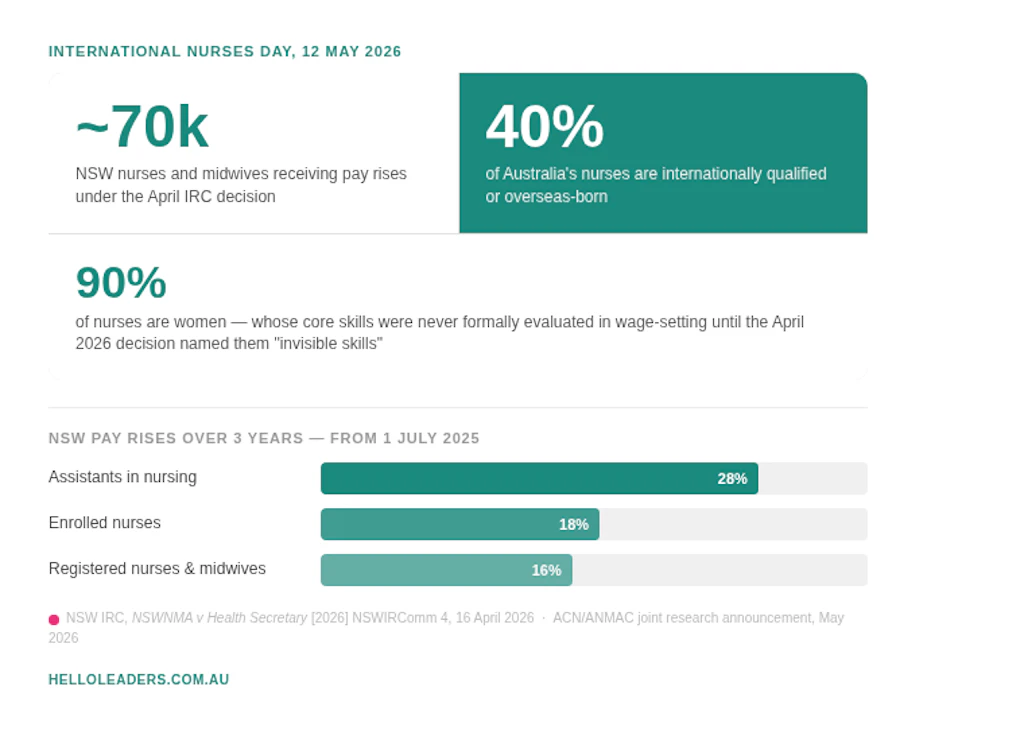
Ninety per cent of nurses are women. The undervaluation follows directly from that.
ACN CEO Adjunct Professor Kathryn Zeitz described the decision’s reach: these skills “have never before been evaluated in the exercise of wage setting,” she said, and “because these skills are gendered in nature and have not been formally recognised, they are known as ‘invisible skills.'”
A court has now said that they count.
They come with a pay rise. The decision delivers increases over 3 years for around 70,000 NSW nurses: 16% for registered nurses and midwives, 18% for enrolled nurses, 28% for assistants in nursing, backdated to 1 July 2025. The increases are largest at the lowest end of the pay structure, where the gap was widest.
The Fair Work Commission completed its own proceedings in 2024, with further wage increases for nurses scheduled from August 2026. What the FWC decides flows to every other state, and the NSW finding will carry weight there.
Zeitz is clear-eyed about the distance that remains. “There remains significant work to be done on pay equity, sick leave and flexible working arrangements,” she said. “Nonetheless, this decision represents a step forward for the nursing profession.”
The other 40 per cent
The April decision addresses what nursing requires. The research announced this month is asking who has been providing it.
Forty per cent of Australia’s nurses are internationally qualified or overseas-born. Despite making up that share of the workforce, they remain underrepresented in management and leadership across the system. A joint research project from the Australian College of Nursing and ANMAC, which will work with a cohort at Canberra Health Services over 12 months, is designed to understand the shape of that gap.
Zeitz doesn’t hedge on what drives it.
“It is no exaggeration to say that the Australian healthcare system would not function without overseas-born nurses,” she said. “Yet too often their skills and experience are overlooked, and they’re marginalised and subject to racism. We need to build the evidence to enhance employers and policymakers’ understanding of the positives internationally qualified nurses bring to the nursing profession.”
ANMAC CEO Camilla Rowland defines what the research is built around: understanding “their migration journey, workplace integration and career progression,” and how those factors shape whether internationally qualified nurses are able to progress. The evidence base for effective policy here is thin. The project is an attempt to change that.
Both threads are visible on International Nurses Day. The skills were invisible. Too many of the nurses who carry them have been, too.


