
Working Future White Paper shows the care economy is a priority
The Federal Government’s Working Future White Paper provides a detailed roadmap for the future of our workforce, with aged care and the care economy a recurring talking point.
Published on 28 September 2023

The Federal Government’s Working Future: The Australian Government’s White Paper on Jobs and Opportunities is the latest roadmap to strengthening Australia’s labour market. Released on Monday, it has arguably reinforced the belief that the Government is well and truly invested in the aged care industry for the long term.
The Employment White Paper is an expansive document focused on ten policy areas such as Planning for our future workforce and Investing in Skills, tertiary education and lifelong learning. It also presents 31 future reform directions for all industries, with aged care and the care economy a recurring theme. These are the main points.
Investing in skills and training
Two of the White Paper’s major objectives are to fill skills needs and build Australia’s future workforce. This is by no means an easy feat, but it’s integral to sustaining the care sector.
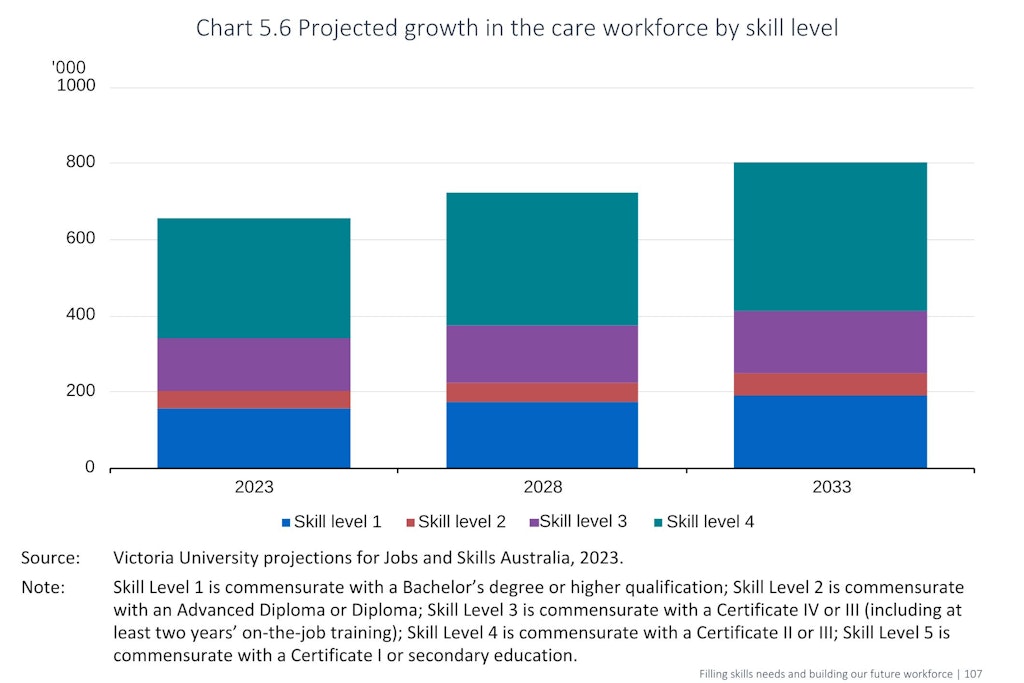
“Some rapidly growing industries are facing acute skills shortages and will require tailored workforce solutions. This requires investments in domestic skills and training, complemented by targeted migration pathways. Projections produced by Victoria University for Jobs and Skills Australia show that… the care and support economy is expected to grow by 22% by 2033,” the White Paper stated.
Additionally, it said employment in the care and support sector is expected to double over the next 40 years due to growth in the ageing population and increased access to formal care services.
With over 800,000 workers needed for the care economy by 2033, many of those requiring Skill Level 4 qualifications at least (Certificate II or III), the sector will be one to benefit from a $41 million TAFE boost by the Federal Government. This will lead to:
- The creation of six new TAFE Centres of Excellence
- New apprenticeship opportunities for the care economy sector
- A faster uptake of higher apprenticeships, with the hope to double apprenticeship numbers within five years
- 300,000 additional Fee-Free TAFE places in areas of skills shortage from 2024
“We are a sector that relies on qualified people… we need a highly qualified workforce. We need much greater cooperation between the education sector and our sector to make sure the qualifications are the right ones and we have enough people choosing our sector as a career,” Tom Symondson, Aged & Community Care Providers Association CEO, told ABC News.
Other key points
- The development of a national skills passport will begin shortly with the aim of connecting workers looking for a new job with employers seeking their specific qualifications.
- Issues with unpaid work placements were also identified, with the White Paper calling for more training places to be readily available and on-the-job training, especially in regional areas.
- Older Australians will have more flexibility to work under changes to the Age Pension, which may benefit worker longevity in aged care settings.
- Although no specific details were mentioned, the Government will develop strategies to help the sector adopt technologies to reduce strenuous, repetitive or administrative tasks while also streamlining regulatory burden.
Secure and fair pay
Having just passed a fully-funded 15% interim wage increase for aged care workers this year, the Government remains committed to ensuring all jobs are secure and fairly paid. It has identified low-paying jobs as a risk to workforce attraction and retention.
Currently, it’s unclear whether this means further raises are on the way for aged care workers who missed out on the 15% boost, with stakeholders and advocates currently lobbying the Fair Work Commission to make it industry-wide. But it is promising to see continued discussions surrounding aged care wages.
“[The White Paper] highlighted a number of things that we’re trying to do in aged care to move towards that target. We are increasing wages, but we certainly need to do more of that across the care economy,” Mr Symondson told ABC News.
“It’s a good start. We have a long way to go. There are huge shortages of workers, as the Paper points out, and it’s not going to be an overnight fix.”
Other key points
- Direct employment will be preferenced in aged care to ensure the workforce contains more full-time and part-time employees with secure work.
- The definition of casual employment will become fairer to strengthen the employment relationship and create clearer pathways to permanency for casual employees if they are working like a permanent employee.
- More work is required to achieve gender equality for women in the workforce, including more accessible early childhood education and care and narrowing gender gaps in superannuation. A National Strategy to Achieve Gender Equality will be established.
Skilled Migration boost
Although the Government is determined to boost the care economy workforce with locally trained and educated workers, it recognised the need to improve skilled migration pathways.
There are several regulatory barriers to recruiting skilled migrants and streamlining and shortening the process would help to reduce costs and bring in more high-quality health care candidates, such as nurses, physicians and pharmacists.
In reforming the migration system to better attract highly skilled workers and combat worker exploitation, the Government has already raised the Temporary Skilled Migration Income Threshold, and it will now look to “realign skilled migration with Australia’s priorities’ so it can positively contribute to productivity growth.
“[Migration] has been a huge part of our past, it will be a huge part of our future. We are still a relatively difficult country to get into as a qualified aged care worker… because it takes a long time to have your qualifications recognised if you’ve trained overseas,” Mr Symondson said.


